Vermont
The Green Mountain State
Quick Stats
Map
Seal & Motto
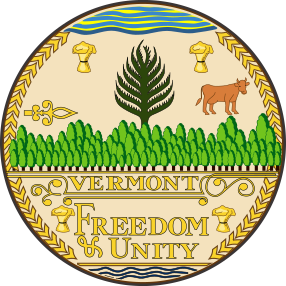
“Freedom and Unity”
Vermont’s motto captures the founding tension at the heart of its independent spirit: personal liberty must be balanced by community solidarity. Adopted when Vermont joined the Union in 1791, these two words reflect the ethos of a state that abolished slavery before it was a state, survived as its own republic for 14 years, and has long prioritized civic engagement alongside individual freedom.
State Flag
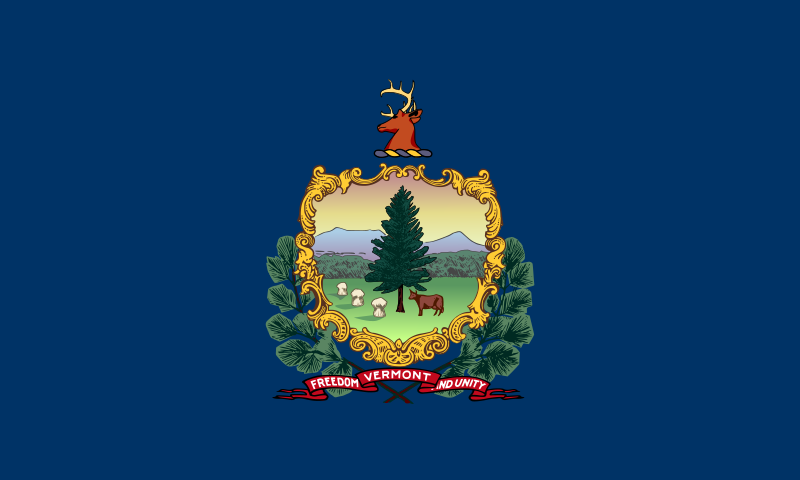
Vermont’s flag displays the state coat of arms on a deep blue field. The coat of arms features a pine tree, a cow, and wheat sheaves flanked by two pine boughs, with a deer’s head above, the motto ribbon below, and “Vermont” arched at the top. Adopted in 1923, it symbolizes Vermont’s agricultural heritage and natural abundance.
- Blue Field — The deep royal-blue background evokes Vermont’s clear mountain skies and the cool, clean air of the Green Mountains that have defined the state’s character since the first settlers arrived.
- Pine Tree — The central white pine on the coat of arms represents Vermont’s vast forest cover, the Green Mountain landscape, and the timber industry that was central to Vermont’s early economy and identity.
- Cow & Wheat — A Holstein cow and sheaves of wheat flank the tree, representing Vermont’s storied dairy farming heritage — the state leads the nation in dairy production per capita and is synonymous with quality Vermont cheddar.
- Deer’s Head & Motto — A leaping deer crowns the shield, symbolizing Vermont’s abundant wildlife, while the motto ribbon “Freedom and Unity” below captures the twin ideals of personal liberty and collective responsibility.
State Symbols
Overview
Vermont is a jewel of New England — a state so small, so pristine, and so fiercely independent that it once existed as its own republic for 14 years before joining the Union. Its blazing autumn foliage, covered wooden bridges, hand-crafted artisan culture, legendary maple syrup, and world-class ski mountains have made it an enduring symbol of an America that prizes quality and natural beauty above all else. With fewer people than most cities, Vermont punches far above its weight in culture, policy, and national character.
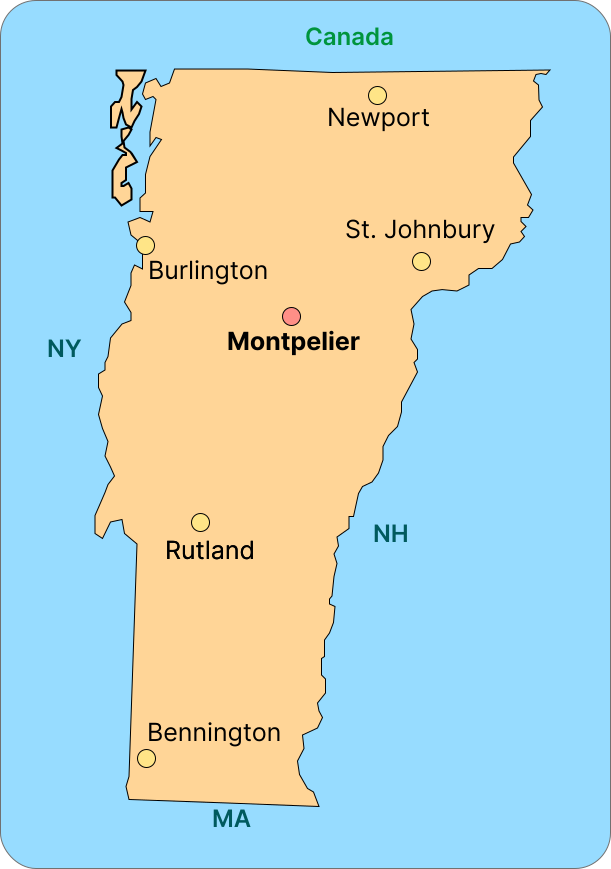
Geographically, it is uniquely isolated and does not share land borders with any other U.S. state.
Historical Significance
Vermont became the 14th state on March 4, 1791, following 14 years as the independent Vermont Republic — complete with its own currency, postal service, and 1777 constitution that was the first in U.S. history to abolish slavery. Ethan Allen’s Green Mountain Boys captured Fort Ticonderoga from the British in May 1775, the first American offensive victory of the Revolution, and Vermont’s fierce localism and progressive values have defined its political character ever since.
Fascinating People
Top Cities & Hubs
Burlington
Population: ~45,000Vermont’s largest city and cultural capital — a vibrant lakeside hub on Lake Champlain home to the University of Vermont, a nationally celebrated Church Street pedestrian marketplace, and the progressive politics that launched Bernie Sanders to national prominence.
South Burlington
Population: ~20,000Vermont’s second-largest city, a commercial hub housing Burlington International Airport, major retail corridors, and technology companies contributing to the state’s growing innovation economy.
Rutland
Population: ~16,000Known historically as “Marble City” for its world-famous marble quarries, Rutland is the commercial center of central Vermont and a gateway to Killington and Pico Mountain ski resorts.
Barre
Population: ~9,000The “Granite Capital of the World” — Barre’s Rock of Ages quarry is the largest deep-hole granite quarry in the world, producing fine-grained grey granite used in monuments across North America.
Montpelier
Population: ~8,000The smallest state capital in the U.S. by population — a charming historic city on the Winooski River known for its gold-domed statehouse, vibrant local food scene, and the New England Culinary Institute.
How Vermont Ranks
Vermont produces approximately 50% of all U.S. maple syrup — more than 2 million gallons annually from over 1,500 maple farms — despite being the second-smallest state by population.
Vermont consistently ranks among the healthiest states in America by America’s Health Rankings, with low obesity rates, high physical activity levels, excellent air quality, and strong preventive care access.
Vermont leads the nation in craft breweries per capita, home to The Alchemist (maker of the legendary Heady Topper IPA), Hill Farmstead, and over 60 craft breweries in a state of fewer than 650,000 people.
Vermont consistently ranks among the five least-obese states, reflecting a culture of outdoor recreation, farm-to-table eating, skiing, hiking, and cycling that permeates everyday life in the Green Mountains.
Key Landmarks & Economy
Did You Know?
- Vermont's constitution of 1777 was the first in U.S. history to prohibit slavery and the first to grant universal male suffrage regardless of property ownership.
- Vermont produces more maple syrup per capita than any other state, generating about 50% of the entire U.S. maple syrup supply from over 1,500 maple farms despite being the second-smallest state by population.
- Vermont is the only New England state that does not border the Atlantic Ocean, and Montpelier is the only U.S. state capital without a McDonald's within its city limits.